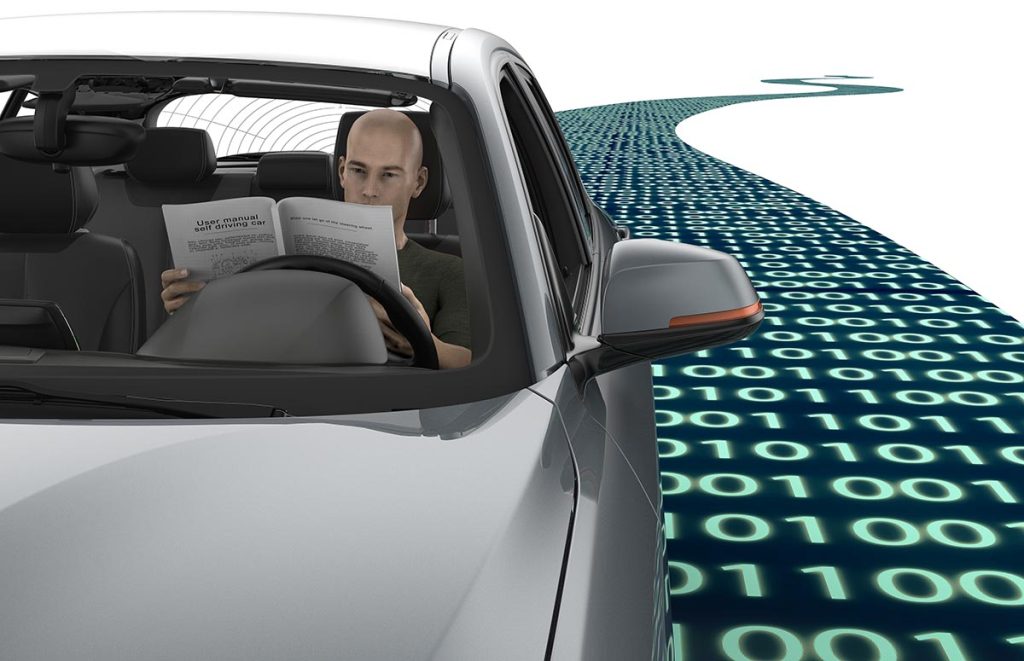
What drives you? Self-driving cars may help avoid personal injury in Ft. Lauderdale crashes . . . but are these the wave of the future?
Here is an interesting question: In a new world of self-driving cars, who is at fault in the event of a Fort Lauderdale crash and a personal injury claim?
This is an issue that has lawmakers, police, and attorneys puzzling, because of the myriad problems associated with a motor vehicle crash involving personal injury. While Florida has yet to make self-driving vehicles legal, it is a looming possibility, as their probability becomes more and more mainstream.
It is a fact that 90 percent of all crashes are caused by driver error. By employing this logic, is it possible that these crashes could be prevented by self-driving vehicles? If you take human error out of the equation, what is left? Robotic error? Digital error?
There is a wealth of information out there which holds that, as more features become automated on our motor vehicles, the number of crashes in which we are involved will decrease, thereby decreasing the number of personal injury cases. Does this also mean that car owners will need less insurance coverage, causing a drop in rates? Would insurance companies allow such a loss in premium rates, which some estimate could fall as much as 60 percent into the next decade?
These are tough debates. The over-arching issue facing everyone in the self-driving arena involves determining who is at fault in the event of a crash. Florida is a no-fault state in the payout of insurance claims after an accident, which means that all drivers are required to carry auto insurance that pays personal injury protection (PIP) benefits. After an accident, PIP pays for medical and some non-medical expenses that were incurred as a result of the crash, such as lost wages, etc. These benefits are applied no matter who caused the accident.
The issue of who is at fault in a driverless car accident has been worked out, in part, with carmakers such as Mercedes, Volvo, who have asserted that their companies would assume the responsibility in cases involving their vehicles. According to an article on the subject in Scientific American, “. . .Volvo declared that it would pay for any injuries or property damage caused by its fully autonomous IntelliSafe Autopilot system, which is scheduled to debut in the company’s cars by 2020. The thinking behind the decision, explains Erik Coelingh, Volvo’s senior technical leader for safety and driver-support technologies, is that Autopilot will include so many redundant and backup systems – duplicate cameras, radars, batteries, brakes, computers, steering actuators – that a human driver will never need to intervene and thus cannot be at fault.”
So while the trend toward a driverless South Florida may be still a few years out; in the meantime, other technologies can be used to help Fort Lauderdale drivers minimize the occurrence of motor vehicle accidents, and hence, personal injury. Such technology does not take humans out of the equation but warns the driver of imminent danger, such as an approaching object, going as far as braking the vehicle automatically. This is achieved through a series of sensors built into the vehicle that warn the driver. These warnings are done in several ways, through a vibration in the steering wheel, flashing lights, warning sounds and even an automated voice that alerts the driver to oncoming hazards. Such features have been employed by automakers such as BMW for years but the reason more companies have not built these warning sensors into their own cars has to do with profits, with only the highest tier models offering such features, amid claims that these features are cost prohibitive to make standard in other car models.
Outside of the manufacturers adopting such technology, to what extent do consumers value the prospect of fully self-driving cars? According to research from auto-rater Edmunds, not much. Edmunds cites research from Brandon Schoettle and Michael Sivak of the University of Michigan Transportation Research Institute, which reveals that based on a survey of 618 U.S drivers, “45.8 percent of respondents prefer no self-driving capability at all.”
“Another 38.7 percent said they’d accept a partially autonomous vehicle, but just 15.5 percent of those surveyed said they’d want a fully self-driving car” the Edmunds article states. “And when it comes to riding as a passenger in a completely self-driving car, 66.6 percent of respondents said they’d be ‘very or moderately concerned,’ compared to 50.7 percent in a partially autonomous vehicle. Only 9.7 percent of those surveyed said they wouldn’t be at all concerned about riding in a completely self-driving car.”
Older drivers, as might be expected, were more skeptical than the younger ones, with 45.2 percent of those over 60 saying they’d be very concerned about riding in a self-driving car, compared to 26.1 percent of those aged 18-29, states the Edmunds article.
So the future of self-driving vehicles, and their impact on personal injury insurance claims in the instant of an accident, is yet to be determined, along with testing the claims of the automakers that they will be the ones to pay in a self-driving accident. Little exists on the subject in current case law, with limited litigation occurring, as of yet, when it comes to features such as automatic braking or automatic steering of a car to avoid a crash.
As stated on Edmunds.com, “a new coalition formed by Google, Ford, Uber, Lyft and Volvo plans to ‘work with lawmakers, regulators and the public to realize the safety and societal benefits of self-driving vehicles.’
Since we have seen first-hand the types of serious personal injuries that arise from car crashes in Fort Lauderdale, we are all for technology that can help the driver avoid accidents and personal injury. But until that day comes – and even afterward – we will continue to advise anyone in a car accident to seek counsel immediately, so that their claims can be processed efficiently and so they can be awarded the benefits they need to pay for injuries and to get their lives back in order.